The Norwell Acre You Bought Isn't Always The Acre You Can Build On
August 27, 2026
August 27, 2026
A buyer under agreement on a wooded parcel near the North River calls her surveyor to confirm setbacks before the addition goes to permit. The deed says 1.4 acres. The surveyor's plan, once the Conservation Commission's wetland line gets drawn on it, shows something smaller. Norwell's zoning bylaw does not count wetlands toward the one-acre minimum every lot needs to build on, so a chunk of that 1.4 acres was never buildable in the town's eyes to begin with. Nothing about the sale was wrong. The listing sheet just measured the wrong thing.
This is the piece of Norwell zoning that catches people mid-transaction more than any other, and it is worth understanding before you write an offer, not after your architect calls with bad news.
Norwell requires a minimum lot size of one acre in every residential district, along with 80 feet of street frontage and 150 feet of lot width, measured parallel to the frontage. Those numbers are straightforward. What trips people up is what the town excludes from the calculation. Under the zoning bylaw, no part of a lot that the Conservation Commission determines to be a coastal or freshwater wetland, as defined by the state's Wetlands Protection Act, counts toward that one-acre minimum. Land tied up in a stormwater management system is excluded too.
On top of the acreage rule, every dwelling has to fit inside an imaginary circle at least 150 feet in diameter, and that circle has to sit entirely on upland. A lot can technically meet the one-acre threshold on paper and still fail to offer a spot where a house, a septic system, and a driveway all fit inside that circle once the wetland boundary is drawn.
Here is the bylaw in short form, the way it actually functions for a buyer reading a listing:
| Requirement | What the bylaw says |
|---|---|
| Minimum lot size | One acre, all residential districts |
| Minimum frontage | 80 feet |
| Minimum lot width | 150 feet |
| Upland building circle | 150-foot diameter, entirely on upland |
| Side and rear setback | 20 feet in Residential Districts A and B |
| What counts toward the acre | Upland only |
| What doesn't count | Wetlands (coastal or freshwater), stormwater management areas |
Older lots get some protection. If a parcel was lawfully laid out and recorded before the current rule took effect, or shown on an endorsed Approval Not Required plan, or on a definitive subdivision plan approved under the Subdivision Control Law before the wetland exclusion applied, it can still qualify under the requirements in place when it was created. That grandfathering matters for a lot of older Norwell parcels, but it is not something to assume. It is something to confirm with the plan itself.
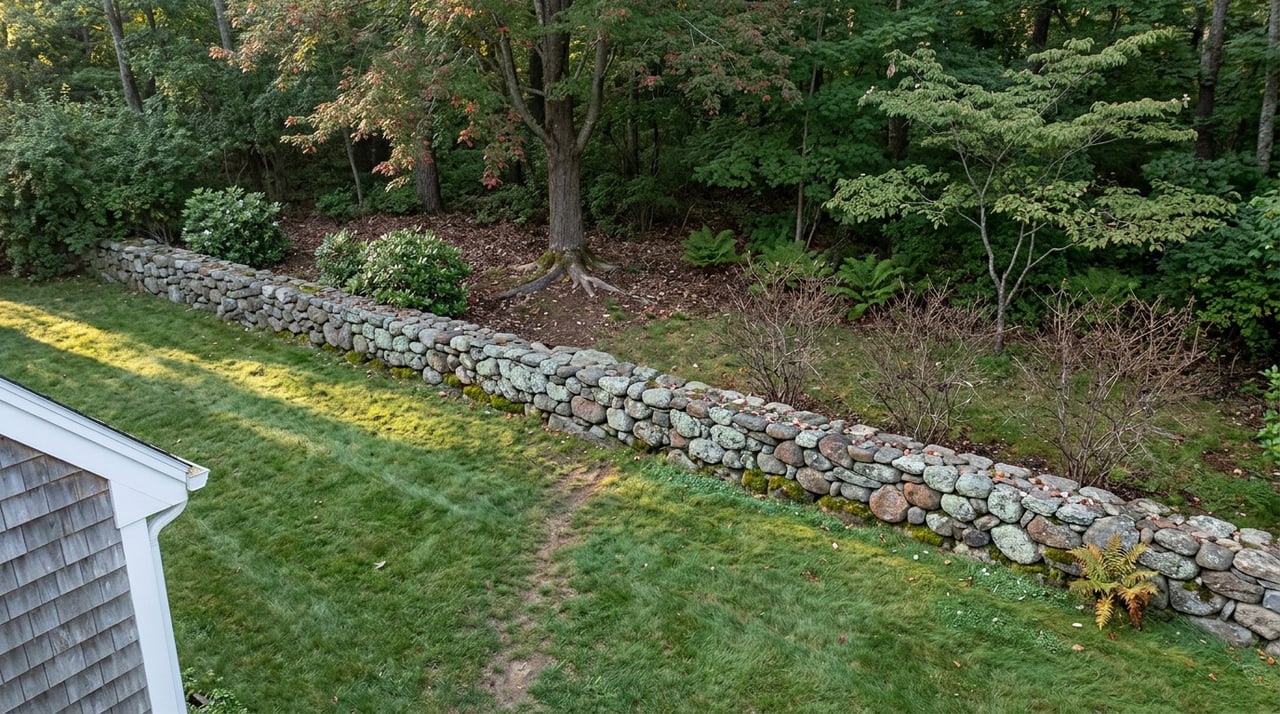
This is not evenly distributed across town. The parcels most likely to have real daylight between deed acreage and buildable acreage sit along the North River and South River corridors, including the stretch near Bridge Street and the Town Landing. Lots here tend to run one to three acres or more, wooded and private, which sounds like a selling point until you realize the wetland fringe along a riverbank is exactly the kind of acreage the town won't count.
The same pattern shows up around Norwell's inland conservation land. Pockets near Norris Reservation, Jacobs Pond, Knapp Conservation, and Black Pond hold custom homes in the 3,000 to 5,000 square foot range on one to three acre parcels, streets like Mt Blue among them. Privacy and trail access are the draw, and they come with the same wetland-versus-buildable math as the riverfront lots.
Compare that to the newer subdivisions closer to Route 3 and the southern town line, popular with commuters. Zoning minimums still apply there too, so most lots run one acre or more, but they were built out on drier, more uniform ground. The gap between deed acreage and buildable acreage tends to be smaller and more predictable in that part of town, which is worth knowing if a large, flexible building envelope matters more to you than a wooded lot line.
If your parcel does contain wetland resource area, and your project touches it or comes close, you are not just losing acreage from the zoning calculation. You are looking at a filing with the Conservation Commission before you can build. That review typically adds 30 to 90 days to a project timeline and runs somewhere between $5,000 and $15,000 in consulting and engineering costs, depending on what the parcel requires. For a buyer planning an addition, a pool, or a detached garage right after closing, that is a schedule and budget line that needs to be built in from the start, not discovered afterward.
Norwell has no public sewer system to speak of. Homes here run on private septic, governed by Title 5, and the town's Board of Health layers its own requirements on top of the state standard where it sees fit. A meaningful share of properties also draw drinking water from private wells rather than a municipal line, which means before you can put a well into service, the Board of Health has to approve it, and your site plan has to show the well's location along with every septic system and contamination source within 200 feet.
There is a technical detail buried in the sewage bylaw that matters more than it sounds like it should: any septic component has to keep a 10-foot setback from waterlines. On a smaller or oddly shaped buildable envelope, that setback can be the difference between a straightforward septic layout and one that needs an engineered workaround. If you are buying a home on a private well, a water quality test before closing is a reasonable step regardless of what the listing says about the system's age or condition. It is the kind of due diligence that costs little and tells you something the paperwork alone cannot.
Much of town also sits inside the Aquifer Protection District, an overlay tied to a 2010 town map of the wellhead protection area. It does not affect what you can build on a typical residential lot, but it does restrict certain commercial uses nearby, car washes and dry cleaning operations among them, because the town has an explicit interest in protecting the groundwater residents and wells depend on.
Norwell adopted a Protected ADU bylaw at the May 5, 2025 Annual Town Meeting, Article 43, allowing one accessory dwelling unit per lot as of right, no special permit or variance required. That is good news for a lot of buyers weighing an in-law setup or rental income, but the bylaw was written with Norwell's own upland rule in mind.
A few specifics worth knowing before you count on this:
If you are shopping with an ADU in mind, the acreage question stops being academic. A 1.1 acre lot with a third of it in wetland does not clear the one-acre-of-upland bar, even though the deed says otherwise.
Homes clustered around the town common fall inside the Norwell Village Area Historic District, which groups 34 contributing buildings. Buying or renovating in that footprint means an additional layer of design review beyond standard zoning, on top of everything above. It is not a reason to avoid the village center. It is a reason to ask early what that review actually requires for your specific project.
Norwell's tolerance for stretching a small, older lot into a much larger house has already been tested in court. In Bjorklund v. Zoning Board of Appeals of Norwell, the Massachusetts Supreme Judicial Court upheld the town's ability to stop a homeowner from tearing down a small house and replacing it with a bigger one on a nonconforming lot. The court's own language on the trend is blunt: "many municipalities do not welcome the building of structures that represent the popular trend of 'mansionization.'" If your plan for a Norwell property involves buying small and building big on a tight, older lot, that 2008 decision is the reason to have the zoning conversation with the town before you assume anything about scale.
Does every Norwell lot need a Conservation Commission filing? No. Only parcels where wetland resource area exists on or near the buildable envelope typically trigger a filing. A survey with the wetland line drawn is the fastest way to know where you stand.
Can I still build an ADU if part of my lot is wetland? Only if at least one acre of upland remains after the wetland is excluded, and only if the Board of Health confirms your septic system can handle the added load, reserve area included.
Is public sewer coming to Norwell? Nothing in current town planning points to that. Private septic under Title 5 remains the standard, which is why buildable acreage and septic siting stay tied together here in a way they are not in towns with public sewer service.
Does the historic district rule apply outside the village center? No, it is specific to the 34 contributing buildings grouped around the town common. Properties outside that footprint follow standard zoning review only.
If you are looking at a Norwell property and want to know what its acreage actually supports before you write an offer, or you are preparing to sell a lot where the buildable envelope tells a better story than the deed number alone, Kornerstone can walk the parcel with you and make sure the numbers you're building a decision on are the ones that matter. Schedule a complimentary Koncierge consultation and we'll start with the survey, not the listing sheet.
Stay up to date on the latest trends in real estate.
September 17, 2026
September 10, 2026
September 3, 2026
September 3, 2026
August 27, 2026
August 20, 2026
August 13, 2026
August 6, 2026
July 23, 2026
Let us learn more about how I can help. My goal is to be your Real Estate Consultant for Life!